Este artículo presenta un análisis interdisciplinario del caso de Juliana, mujer guaraní que en 1541 decidió liberarse de su condición de mujer esclavizada envenenando al esclavista español Nuño de Cabrera en la ciudad de Asunción. A partir del proceso judicial conservado en el Archivo Nacional de Asunción y testimonios posteriores de Pero Hernández y Alvar Núñez Cabeza de Vaca, exploramos tanto la materialidad histórica como sus resignificaciones literarias contemporáneas. La primera parte reconstruye el sistema de servidumbre y violencia sexual hacia las mujeres indígenas (1537-1550), contextualizando la resistencia de Juliana dentro de la transformación del cuñadazgo en el sistema de rancheadas y de esclavitud generalizada. El análisis documental revela que fue procesada dos veces, liberada inicialmente por Domingo Martínez de Irala, arengó públicamente a otras mujeres indígenas de la ciudad por haber asesinado a su opresor, provocando nuevamente su arresto y ejecución por Alvar Núñez Cabeza de Vaca. La difusión pública del asesinato como acto de resistencia por parte de Juliana constituye una evidencia extraordinaria de una consciencia política anticolonial profunda y una pedagogía de la resistencia. La segunda parte examina cómo la literatura paraguaya (siglos XX-XXI) ha reescrito a Juliana, oscilando entre narrativas de erotización colonial y reivindicaciones como líder rebelde. Estas representaciones revelan tensiones en la construcción de la identidad nacional paraguaya y el lugar de las mujeres indígenas en el imaginario colectivo. El diálogo entre archivo y memoria permite reflexionar sobre las responsabilidades metodológicas y éticas de escribir la historia de individuos racializados cuyas voces llegan mediante múltiples mediaciones coloniales.
@article{candela_juliana_2026,title={Entre el archivo y la memoria: la "India Juliana" en la documentación colonial y sus representaciones culturales en Paraguay},author={Candela, Guillaume},journal={Revista Estudios Paraguayos},address={Asunción, Paraguay},year={2026},doi={10.47133/respy44-26-1-1a-01},}
ICANH
Resistencias y resiliencias indígenas y africanas en el Paraguay colonial temprano
This article examines Indigenous, African, and Afro-Paraguayan resistances and resiliences in early colonial Paraguay. The study analyses a collection of judicial documents revealing trajectories such as those of Diego Bretón - an Afro-Iberian organizing interethnic conspiracy-, Gonzalo Mayrayu - a Guaraní leader claiming territorial sovereignty -, Juan Blanco - an enslaved African fighting with legal knowledge -, and Juliana - a Guaraní woman using botanical knowledge to poison her master -. Paraguay functioned as an experimental laboratory where interethnic alliances challenged official colonial narratives. Through a reading against the grain of sources produced by the colonial administration, the article reveals how certain individuals from racialized populations deployed forms of knowledge and agency that exceeded, and at times subverted, the subordinate roles assigned to them by the colonial order.
@article{candela_resistencias_2026,title={Resistencias y resiliencias indígenas y africanas en el Paraguay colonial temprano},author={Candela, Guillaume},journal={Fronteras de la Historia},publisher={Instituto Colombiano de Antropología e Historia},address={Bogotá, Colombia},year={2026},doi={10.22380/20274688.3192},}
BLAR
Neither Cuñado nor Cuñadazgo: A Guaraní History of Spanish Colonisation
This article examines the complex relationships between Spaniards and Guaraní peoples in the Río de la Plata province during the sixteenth and seventeenth centuries. It challenges prevailing historiographical narratives regarding a purportedly "harmonious miscegenation" and questions the characterisation of Spanish colonisation in Paraguay as founded upon kinship relations between Spaniards and Guaraní. Through rigorous archival analysis, the study demonstrates that colonial documentation reveals profoundly asymmetric power relations regulated through slavery, servitude, and sexual violence. The research critically evaluates the deployment of the Spanish term "brother-in-law" (cuñado) in translating Guaraní concepts, determining that this terminology indicated colonial domination rather than genuine kinship bonds. The analysis recovers Indigenous voices expressing resistance to Spanish control whilst genealogical reconstruction of a Guaraní family illuminates the devastating effects of colonisation. This article proposes new methodological approaches for understanding the contributions of Indigenous history and colonial practices affecting Indigenous peoples.
@article{candela_ni_2026,title={Neither Cuñado nor Cuñadazgo: A Guaraní History of Spanish Colonisation},author={Candela, Guillaume},journal={Bulletin of Latin American Research},publisher={Society for Latin American Studies},address={UK},year={2026},doi={10.1111/blar.70068},}
Palgrave
Digital methods for colonial Latin American history
Guillaume Candela and Patricia Murrieta Flores
In The Palgrave Handbook of Digital Latin American Studies, 2026
@incollection{candela_murrieta_digital_2026,title={Digital methods for colonial Latin American history},author={Candela, Guillaume and Murrieta Flores, Patricia},booktitle={The Palgrave Handbook of Digital Latin American Studies},publisher={Springer Nature},year={2026},note={In press}}
Review
Book Review: Carlos A. Jáuregui and David M. Solodkow, Bartolomé de las Casas y el paradigma biopolítico de la modernidad colonial. Madrid, Frankfurt: Iberoamericana-Vervuert y Ediciones Uniandes, 2024
@article{candela_review_jauregui_2026,title={Book Review: Carlos A. Jáuregui and David M. Solodkow, Bartolomé de las Casas y el paradigma biopolítico de la modernidad colonial. Madrid, Frankfurt: Iberoamericana-Vervuert y Ediciones Uniandes, 2024},author={Candela, Guillaume},journal={Procesos. Revista Ecuatoriana de Historia},publisher={Universidad Andina Simón Bolívar},year={2026},note={In preparation}}
2024
RHA
El Paraguay colonial, ¿una "isla rodeada de tierra"? Movimientos transcontinentales y transoceánicos en la ciudad de Asunción (siglos XVI-XVII)
This article challenges the predominant notion among historians that early colonial Paraguay was an ’island surrounded by land’ disconnected from the rest of the Spanish empire and the world. Through an examination of archival documents from the 16th and 17th centuries, the work unveils the surprising ethnic, cultural, and linguistic diversity of the region. Case studies are presented of Africans, Afro-descendants, indigenous people from throughout America, as well as Europeans of diverse origins (English, Italians, Greeks, French, Germans) who found their way to Asunción and this supposed frontier backwater. Their mobility, movements, and connections across the Spanish Empire are traced through legal records, letters, wills, and court cases. The experiences of individuals such as the maroon leader Diego Bretón, the Greek carpenter Estamate Cámara, the French gunpowder maker Julián, or the German soldier Ulrich Schmidl belie any notion of an insular and monocultural Paraguay in this period. Far from the mythical Hispanic-Guaraní society, this work portrays a pluralist colonial society immersed in transatlantic and transcontinental movements of peoples and flows of information. Rethinking Paraguay’s past based on long-forgotten primary sources promises to demolish persistent historiographical prejudices that portray it as a historical isolate, stagnating adrift from the broader currents of the early modern world.
@article{candela_paraguay_2024,title={El Paraguay colonial, ¿una "isla rodeada de tierra"? Movimientos transcontinentales y transoceánicos en la ciudad de Asunción (siglos XVI-XVII)},author={Candela, Guillaume},journal={Revista Historia Autónoma},address={Madrid, Spain},year={2024},doi={10.15366/rha2024.25.002},}
UFAM
Pensar la Historia Indígena: una invitación a la reflexión colectiva
Guillaume Candela and Carlos D. Paz
Canoa do Tempo - Revista del Programa de Posgrado en Historia de la Universidad Federal de Amazonas (UFAM), 2024
An invitation to collective reflection on Indigenous History, examining new approaches and methodologies.
@article{candela_paz_pensar_2024,title={Pensar la Historia Indígena: una invitación a la reflexión colectiva},author={Candela, Guillaume and Paz, Carlos D.},journal={Canoa do Tempo - Revista del Programa de Posgrado en Historia de la Universidad Federal de Amazonas (UFAM)},address={Manaus, Brazil},year={2024},doi={10.38047/rct.v16.FC.2024.apdi.p.1.18},}
Review
Book Review: Francismar Alex Lopes de Carvalho, Natives, Iberians, and Imperial Loyalties in the South American Borderlands, 1750-1800
@article{candela_review_carvalho_2024,title={Book Review: Francismar Alex Lopes de Carvalho, Natives, Iberians, and Imperial Loyalties in the South American Borderlands, 1750-1800},author={Candela, Guillaume},journal={Hispanic American Historical Review},year={2024},doi={10.1215/00182168-10943049},}
2023
REP
The "mujeres enamoradas": Prostitution, Amancebamiento and Marriage in Sixteenth-Century Rio de la Plata
This article studies the role of ’women in love’ in the conquest of the Rio de la Plata. A lengthy judicial process found in the National Archive of Asuncion describes the attitude of Spanish elites and their control over women, particularly Spanish prostitute women. This essay shows how these women were powerful agents in this region and aims to understand the daily life of these invisible actors in the conquest-era society. This work examines the complex network between Spanish women and different colonial subjects to understand women’s spaces of power in the early colonial period of the Rio de la Plata.
@article{candela_mujeres_2023,title={The "mujeres enamoradas": Prostitution, Amancebamiento and Marriage in Sixteenth-Century Rio de la Plata},author={Candela, Guillaume},journal={Revista Estudios Paraguayos},address={Asunción, Paraguay},volume={41},number={1},pages={156--184},year={2023},doi={10.47133/respy26002301art05},}
IEHS
En los orígenes del proyecto Paraquaria (1549-1556) – circulaciones epistolares y redes de comunicación para asentar la colonia en el Río de la Plata
The letters of the first Jesuits in America show considerable interest in the Spanish territory of Paraguay. The connections between Spaniards from Asunción, Portuguese from São Vicente and the Jesuits are evidenced in the documentation analysed in this work. Likewise, this study reveals new private networks, such as the Basque network, which permeate the official connections between the overseas territories and the Iberian Peninsula. From the study of the early colonial documentation, we elaborate as a working hypothesis that the "spiritual conquest" of Paraguay led by the Society was born in the mid-sixteenth century through a circulation of information both internal and external to the Order. In this eagerness to reveal new networks of circulation of people and information, we bring to light the need to parallel the circulation of several concepts of the Guaraní language vector, chosen both by the conquest society and by the Jesuits.
@article{candela_origenes_2023,title={En los orígenes del proyecto Paraquaria (1549-1556) -- circulaciones epistolares y redes de comunicación para asentar la colonia en el Río de la Plata},author={Candela, Guillaume},journal={Anuario IEHS},address={Tandil, Argentina},volume={38},number={1},pages={149--165},year={2023},doi={10.37894/ai.v38i1.1688},}
This article discusses the challenges and opportunities in archiving Indigenous history for future generations, highlighting digital preservation methods and community collaboration.
@article{candela_whats_2023,title={What's next? Archiving Indigenous History},author={Candela, Guillaume},journal={Stanford Social Innovation Review},address={Stanford, CA, USA},year={2023},doi={10.48558/pn4k-fb76},}
Press
Hacia una lectura deconstructiva y descolonizadora del archivo
@article{candela_paz_lectura_2023,title={Hacia una lectura deconstructiva y descolonizadora del archivo},author={Candela, Guillaume and Paz, Carlos D.},journal={La Nación},address={Asunción, Paraguay},year={2023},}
Press
Asunción: ¿Cómo se convirtió en la madre de ciudades?
@article{candela_asuncion_madre_2023,title={Asunción: ¿Cómo se convirtió en la madre de ciudades?},author={Candela, Guillaume},journal={ABC Digital},address={Asunción, Paraguay},year={2023},}
2022
MCV
Repenser les fêlures du Paraguay au travers des frontières amérindiennes (XVIe-XVIIe siècle)
This article rethinks the fractures of Paraguay through Amerindian frontiers during the 16th-17th centuries, examining how Indigenous boundaries shaped colonial territories.
@article{candela_repenser_2022,title={Repenser les fêlures du Paraguay au travers des frontières amérindiennes (XVIe-XVIIe siècle)},author={Candela, Guillaume},journal={Mélanges de la Casa de Velázquez},address={Madrid, Spain},publisher={Casa de Velázquez},volume={52},number={2},pages={301--307},year={2022},doi={10.4000/mcv.18222},}
Review
Book Review: Barbara Ganson Ed., Native Peoples, Politics, and Society in Contemporary Paraguay: Multidisciplinary Perspectives
@article{candela_review_ganson_2022,title={Book Review: Barbara Ganson Ed., Native Peoples, Politics, and Society in Contemporary Paraguay: Multidisciplinary Perspectives},author={Candela, Guillaume},journal={Hispanic American Historical Review},volume={102},number={2},pages={365--366},year={2022},doi={10.1215/00182168-9653856},}
Review
Book Review: David E. Tavárez, Words and Worlds Turned around. Indigenous Christianities in Colonial Latin America
@article{candela_review_tavarez_2022,title={Book Review: David E. Tavárez, Words and Worlds Turned around. Indigenous Christianities in Colonial Latin America},author={Candela, Guillaume},journal={Cahiers des Amériques latines},number={97},pages={238--241},year={2022},doi={10.4000/cal.13715},}
This article examines the invisible founders of Asunción, highlighting the Indigenous contributions to the city’s foundation that have been overlooked by traditional historiography.
@article{candela_asuncion_fundadores_2022,title={Asunción y sus fundadores invisibles},author={Candela, Guillaume},journal={La Nación},address={Asunción, Paraguay},year={2022},}
2021
Book
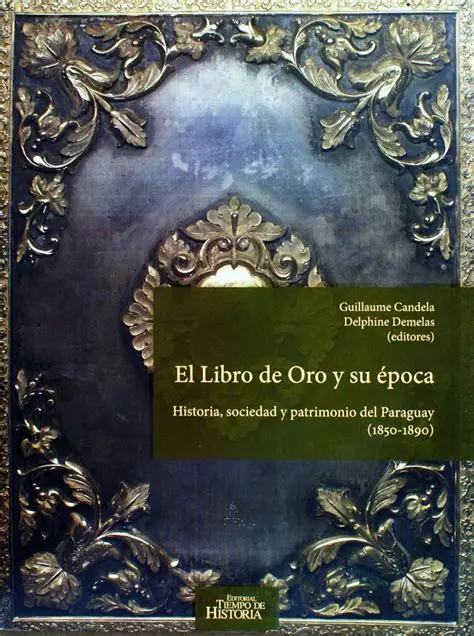
El libro de oro y su época: historia, sociedad y patrimonio del Paraguay (1850-1880)
Guillaume Candela and Delphine Demelas
2021
Edited volume. Reviewed by René Harder Horst in Hispanic American Historical Review, 2023
Presented to Marshal Francisco Solano López in 1867 —in the midst of the War against the Triple Alliance— by women who wished to contribute to the war effort, the Golden Book is not only one of the most beautiful objects in Paraguay’s historical heritage, but also one of the most symbolically charged in the imaginaries woven around female participation in the conflict. However —or perhaps precisely because of this latter point— it was also, until recently, one of the least studied. More than a century and a half after its creation in the workshop of the Asunción goldsmith Ramón Franco, key questions persisted about the "offering of the fair sex," as the press of the time called it: how was the book made and what was its content?; did it really record —as some accounts claimed— a massive donation of jewelry by Paraguayan women?; to what extent was its creation a spontaneous initiative, and what degree of support did it garner? The transfer of the Golden Book to the National Archive of Asunción and its exhibition at the end of 2017 revived public interest and led to the organization of an international colloquium in July 2018 to address, from a multidisciplinary perspective, with the participation of Paraguayan and foreign researchers, the materiality of this patrimonial object, the historical context in which it was produced, and the imaginaries and historiographical interpretations related to the War of the Triple Alliance. This volume, edited by Guillaume Candela and Delphine Demelas, compiles several of the works presented on that occasion, organized around four thematic axes: The Golden Book: materiality, uses and myths; Oblique visions of the Guerra Guasú; National effects and consequences of the War against the Triple Alliance and Integrating indigenous peoples in the context of War at the regional level. Starting from an object that is —as Demelas points out— at the same time document and monument, testimony and attempt to inscribe itself in History, the present book, fruit of the first joint and multidisciplinary effort that addresses it, contributes surprising and new conclusions to the edifice of knowledge about 19th-century Paraguay and promotes greater awareness of heritage, a dialogue between the sciences and new debates on the subject.
@book{candela_libro_2021,title={El libro de oro y su época: historia, sociedad y patrimonio del Paraguay (1850-1880)},editor={Candela, Guillaume and Demelas, Delphine},author={Candela, Guillaume and Demelas, Delphine},year={2021},publisher={Editorial Tiempo de Historia},address={Asunción, Paraguay},isbn={978-99967-981-4-6},pages={198},note={Edited volume. Reviewed by René Harder Horst in Hispanic American Historical Review, 2023}}
Chapter
Denuncia de las atrocidades cometidas en el Paraguay
Guillaume Candela
In Antología del Paraguay - Historia, Cultura, Política, 2021
@incollection{candela_denuncia_2021,title={Denuncia de las atrocidades cometidas en el Paraguay},author={Candela, Guillaume},booktitle={Antología del Paraguay - Historia, Cultura, Política},editor={Lambert, Peter and Nickson, Andrew},publisher={Intercontinental Editora},pages={55--63},year={2021},}
Blog
Las ’mujeres enamoradas’ en la sociedad de conquista del Paraguay: ¿Actores subalternos o protagonistas?
Guillaume Candela
Blog Los reinos de las Indias. Sección Mundus Alter, 2021
@article{candela_mujeres_enamoradas_2021,title={Las 'mujeres enamoradas' en la sociedad de conquista del Paraguay: ¿Actores subalternos o protagonistas?},author={Candela, Guillaume},journal={Blog Los reinos de las Indias. Sección Mundus Alter},number={32},year={2021},}
2020
REP
Marginalidad, precariedad, indianización y middle ground en el Paraguay de la conquista 1526-1575
The peripheral territories of the Spanish Empire seem to differ in terms of their conquest process. To the effects of marginality must be added the absence of mineral wealth, which in turn brings about a great impact on the development of the early colonial Paraguay between 1537 and 1575. All of this leads us in this article to propose a reflection on the adaptation of both the Indigenous Peoples and the colonizers in the face of this new colonial pact, basing our analysis on the concepts of indianization, ethnogenesis, and middle ground.
@article{candela_marginalidad_2020,title={Marginalidad, precariedad, indianización y middle ground en el Paraguay de la conquista 1526-1575},author={Candela, Guillaume},journal={Revista Estudios Paraguayos},address={Asunción, Paraguay},publisher={CEADUC},volume={38},number={1},pages={13--38},year={2020},doi={10.47133/112},}
2019
Brill
Influences of the Lascasian Discourse in Paraguay (Sixteenth Century): the Itinerary of Martín González
Guillaume Candela
In Bartolomé de las Casas, O.P., History, Philosophy, and Theology in the Age of European Expansion, 2019
This chapter examines the influences of Bartolomé de las Casas’s discourse in sixteenth-century Paraguay through the itinerary of priest Martín González.
@incollection{candela_influences_2019,title={Influences of the Lascasian Discourse in Paraguay (Sixteenth Century): the Itinerary of Martín González},author={Candela, Guillaume},booktitle={Bartolomé de las Casas, O.P., History, Philosophy, and Theology in the Age of European Expansion},address={Leiden, Netherlands},publisher={Brill Academic Publishers},pages={392--420},year={2019},doi={10.1163/9789004387669_017},}
2018
Book
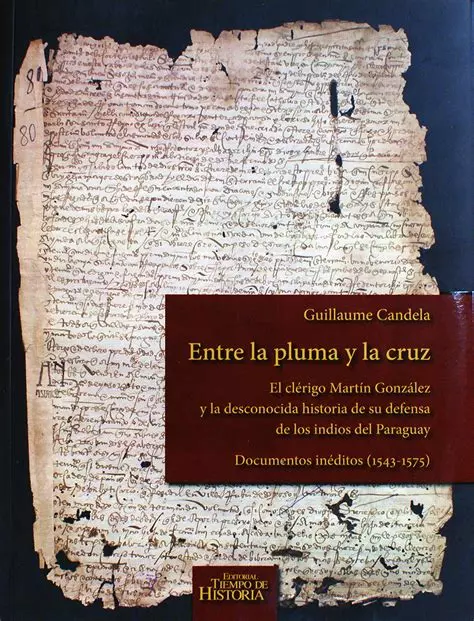
Entre la pluma y la cruz - El clérigo Martín González y la desconocida historia de su defensa de los indios del Paraguay - Documentos inéditos (1543-1575)
Guillaume Candela
Part included in Peter Lambert, Andrew Nickson, Antología del Paraguay - Historia, Cultura, Política, Intercontinental Editora, 2021 , 2018
Selected as one of the best cultural items of the year 2018 by the newspaper El Tiempo de Bogotá (Colombia)
This work transcribes and studies the letters of Martin Gonzalez, a priest who lived in Paraguay between 1542 and 1564 and dedicated his life to the defense of the Guarani from Spanish abuses. This work gives a new vision of the Conquest of Paraguay, long depicted as an idyllic encounter by the historiography of the Rio de la Plata.
@book{candela_entre_2018,title={Entre la pluma y la cruz - El clérigo Martín González y la desconocida historia de su defensa de los indios del Paraguay - Documentos inéditos (1543-1575)},author={Candela, Guillaume},year={2018},publisher={Editorial Tiempo de Historia},address={Asunción, Paraguay},isbn={978-99967-876-3-8},pages={225},}
Chungará
Reflexiones de clérigos y frailes sobre las migraciones indígenas en el Paraguay de la Conquista entre 1542 y 1575
The deportations of Indigenous People in colonial Latin America, also known as rancheadas in the Province of Paraguay, appeared very soon in the epistolary exchanges between the New World and the mother country. The vehement denunciation of the mistreatment of the natives of the continent by some members of the Church, including Brother Bartolome de las Casas, led to a set of new regulations by the Crown. In the Province of Paraguay, despite the absence of mineral wealth, an uncontrolled practice of indigenous service developed. Among the multiple and very diverse complaints of the priests stands out the practice of rancheadas. This paper discusses this practice, highlighting its causes and consequences during the conquest of the Province of Paraguay between 1541 and 1575.
@article{candela_reflexiones_2018,title={Reflexiones de clérigos y frailes sobre las migraciones indígenas en el Paraguay de la Conquista entre 1542 y 1575},author={Candela, Guillaume},journal={Chungará Revista de Antropología Chilena},volume={50},number={2},pages={331--339},year={2018},doi={10.4067/S0717-73562018005000701},}
2017
Press
Una sociedad en los márgenes del Imperio: Escritos y acciones del clero en la Conquista del Paraguay (1537-1580)
@article{candela_sociedad_margenes_2017,title={Una sociedad en los márgenes del Imperio: Escritos y acciones del clero en la Conquista del Paraguay (1537-1580)},author={Candela, Guillaume},journal={Acción},address={Asunción, Paraguay},publisher={CEPAG},year={2017}}
2015
MCV
Lenguas y pueblos tupí-guaraníes en las fuentes de los siglos XVI y XVII
As early as the 16th century, the best-informed reporters on Brazilian and Paraguayan linguistic reality were noting that the groups referred to as «Tupies» and «Guaranies» were in fact «the same people and spoke the same tongue». This article asks how and why two ethnic groups and two languages, Tupi and Guarani, came to be treated as separate. One of the main conclusions emerging from a close examination of 16th-century sources is that the ethnonym «Tupi» was coined by the Spanish to refer to the Indigenous Peoples of the Portuguese coast of Brazil. «Guarani», on the other hand, referred rather to the language spoken in the vast territories explored by the Spanish between Santa Catarina island and the foothills of the Andes by way of Asuncion. We also note that, unlike Quechua or Tupi, Guarani was not considered a lingua franca until very late on, and then only exceptionally.
@article{candela_melia_lenguas_2015,title={Lenguas y pueblos tupí-guaraníes en las fuentes de los siglos XVI y XVII},author={Candela, Guillaume and Melià, Bartomeu},journal={Mélanges de la Casa de Velázquez},address={Madrid, Spain},publisher={Casa de Velázquez},volume={45},number={1},pages={57--76},year={2015},doi={10.4000/mcv.6129},}
Chapter
La fundación de Santa Cruz de la Sierra o la creación de un puente entre dos mundos
@incollection{candela_fundacion_2015,title={La fundación de Santa Cruz de la Sierra o la creación de un puente entre dos mundos},author={Candela, Guillaume},booktitle={En el corazón de América del sur},editor={Martínez, Cecilia and Villar, Diego},volume={2},address={Santa Cruz de la Sierra, Bolivia},publisher={UAGRM},pages={17--38},year={2015},isbn={978-99974-858-8-5}}
Chapter
El fuerte de Buenos Aires en 1541: entre despoblación y destrucción
Guillaume Candela
In Arqueología de los primeros asentamientos urbanos españoles en la América Central y Meridional, Actas del I Seminario internacional RII UC, 2015
@incollection{candela_fuerte_2015,title={El fuerte de Buenos Aires en 1541: entre despoblación y destrucción},author={Candela, Guillaume},booktitle={Arqueología de los primeros asentamientos urbanos españoles en la América Central y Meridional, Actas del I Seminario internacional RII UC},address={Madrid, Spain},publisher={Mairea Libros},pages={289--296},year={2015},isbn={978-84-942794-8-5},}
2014
NMMN
Las mujeres indígenas en la conquista del Paraguay entre 1541 y 1575
This paper aims to study, through the comment of the primary sources collected within the various archives around the world, some cases of Native women who marked the process of conquest in Paraguay between 1537 and 1580. We will analyze the role of the Amerindians in this young colony, and we will deal, more particularly, with the representation of women in the testimonies, with letters of the Spanish sent to the Council of the Indies. This study will handle the first function of the native women in the survival of the conquistadors in this province.
@article{candela_mujeres_indigenas_2014,title={Las mujeres indígenas en la conquista del Paraguay entre 1541 y 1575},author={Candela, Guillaume},journal={Nuevo Mundo Mundos Nuevos},address={Paris, France},publisher={École des hautes études en sciences sociales},year={2014},doi={10.4000/nuevomundo.67133},}
Corpus
Corpus indígenas en la Conquista del Paraguay (siglo XVI)
Guillaume Candela
Corpus Archivos Virtuales de la alteridad americana, 2014
The document chosen for the publication in this dossier includes a series of interrogatories to Indigenous People made by Guarani-speaker interpreters in early colonial Paraguay (1542-1543). This early document raises interest in a stage of conquest in a peripheral zone scarcely studied to date, of which it has often been affirmed that it lacks sufficient sources. The document, conserved at the Archivo General de Indias, reveals the use of ethnic classifications and the interaction between indigenous and conquerors in search of the recognition of the territory and the peoples of Paraguay.
@article{candela_corpus_2014,title={Corpus indígenas en la Conquista del Paraguay (siglo XVI)},author={Candela, Guillaume},journal={Corpus Archivos Virtuales de la alteridad americana},address={Mendoza, Argentina},publisher={Universidad Nacional de Cuyo},volume={4},number={1},year={2014},doi={10.4000/corpusarchivos.718},}
2013
CAFE
Los indios amigos: clé de la réussite de la conquête du Paraguay
Guillaume Candela
C.A.F.E., Cahiers des Amériques – Figures de l’Entre, 2013
@article{candela_indios_2013,title={Los indios amigos: clé de la réussite de la conquête du Paraguay},author={Candela, Guillaume},journal={C.A.F.E., Cahiers des Amériques -- Figures de l'Entre},address={Paris, France},publisher={Les éditions de la Promenade},volume={3},pages={65--80},year={2013},}
Chapter
Comment survivre au Paraguay au temps de la conquête?
Guillaume Candela
In (Re) Découvertes des Amériques. Entre conflits, rencontres et recherche d’identité, 2013
@incollection{candela_comment_2013,title={Comment survivre au Paraguay au temps de la conquête?},author={Candela, Guillaume},booktitle={(Re) Découvertes des Amériques. Entre conflits, rencontres et recherche d'identité},address={Paris, France},publisher={L'Harmattan},pages={37--48},year={2013},isbn={978-2296997639},}
 Entre la pluma y la cruz - El clérigo Martín González y la desconocida historia de su defensa de los indios del Paraguay - Documentos inéditos (1543-1575)Part included in Peter Lambert, Andrew Nickson, Antología del Paraguay - Historia, Cultura, Política, Intercontinental Editora, 2021 , 2018